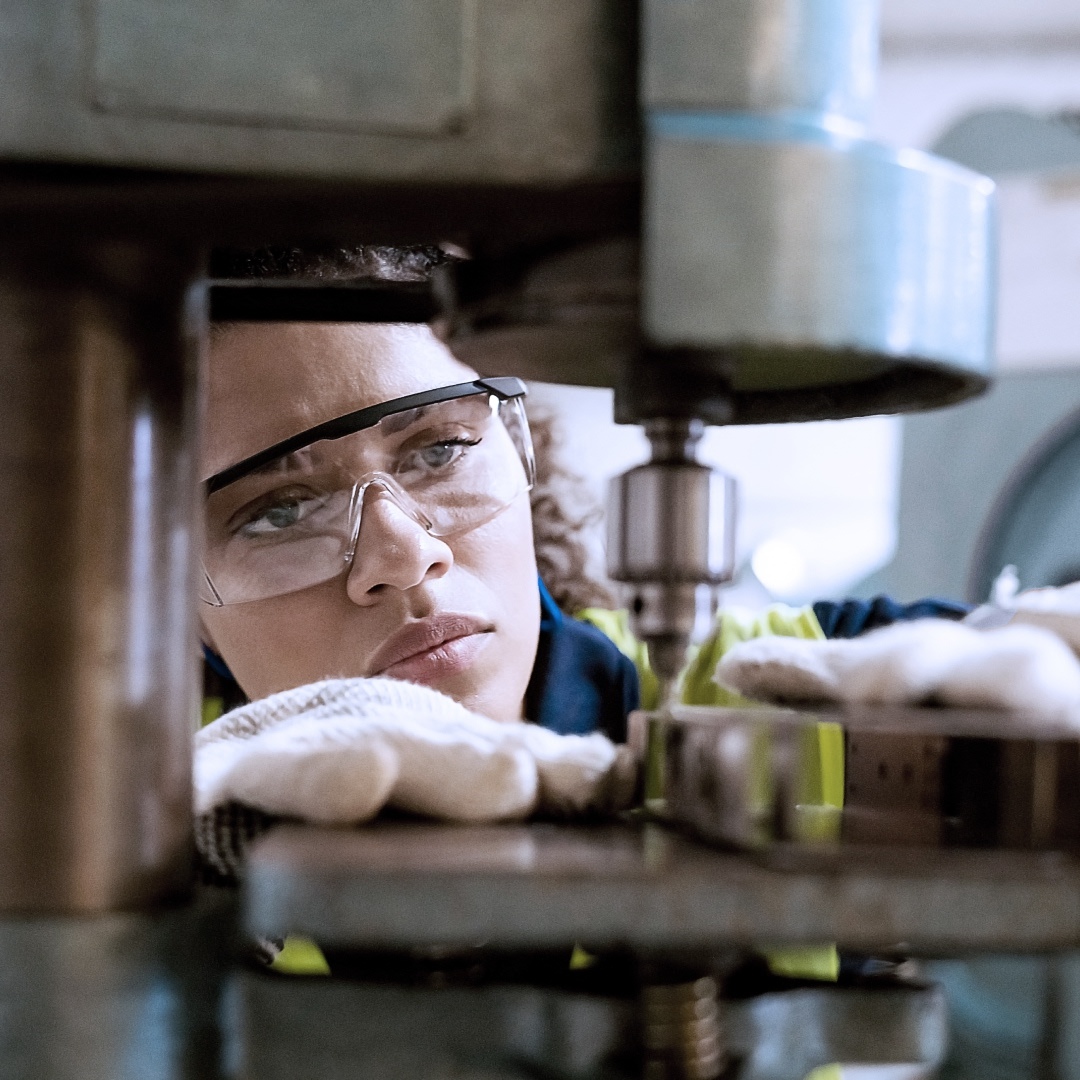
Why is worker leadership becoming increasingly important?
Many manufacturing companies today face similar challenges.
Experienced employees are leaving the company, new colleagues need to be trained more quickly, and at the same time, quality requirements and product variety are constantly increasing.
Written instructions, verbal cues, or individual experience are often no longer sufficient for this.
To ensure that production processes remain stable, employees need exactly the information they require for each specific step—up-to-date, complete, and right at their workstation.
This is exactly where digital operator guidance using a Manufacturing Execution System (MES) comes in.
What problems arise without digital operator guidance?
Missing or outdated work instructions often lead to uncertainty in day-to-day production.
New employees search for information, experienced colleagues find themselves answering the same questions over and over again, and differing interpretations of work processes lead to quality deviations.
On top of that, feedback is often delayed, or information gets lost in paper lists and Excel files.
This results in gaps in communication between planning, production, and quality control.

Unguided manufacturing often means:
- Critical knowledge resides with individual employees.
- Work processes vary depending on the operator.
- Feedback is provided with delays.
- Quality issues are often identified only after scrap has been produced or rework has become necessary.
How does an MES support employees directly at their workstations?
A modern MES guides employees step by step through the manufacturing process.
Orders, work instructions, material information, inspection steps, and confirmations are made available directly at the terminal or mobile workstation. This does not result in an isolated terminal solution.
Rather, the MES integrates production control, detailed planning , and quality management into a single database. Employees receive exactly the information they need for the next step in the process.
Confirmations are fed back immediately to production control, detailed planning, and quality management. This creates a continuous flow of information on the shop floor.
How Digital Worker Guidance Supports Daily Operations
- Keep production schedules and work queues up to date at all times
- Guide employees safely through each process step
- Perform quality inspections directly within the workflow
- Capture feedback and production data without delays
- Access status information at any time
- Reduce questions and interruptions in day-to-day production operations
What are the benefits of digital worker guidance for production and quality?
Digital worker guidance offers more than just digital work instructions. It supports employees directly during the work process, standardizes procedures, and ensures that information is available where it’s needed. As a result, both production and quality assurance benefit from more stable processes and higher data quality.
How do you get started?
Not every production facility needs fully digitized worker guidance right away. In practice, a step-by-step approach has proven effective.
Many companies start with a pilot workstation or a selected production line.
As part of an MES walk, we work together to analyze existing processes, identify data silos, and develop a roadmap for phased implementation.
This leads to quickly visible improvements without unnecessarily disrupting ongoing production processes.